我们相爱吧
Shah Rukh Khan Says His Parents Passing Became The Turning Point of His Life_我的网站

一 | Superstar Shah Rukh Khan was in Dubai for a grand event where he spoke about a moment from his early life that shaped everything that followed. He was attending the launch of a commercial tower that carries his name and shared that the turning point in his journey happened long before he stepped into Bollywood. Standing beside his close friend Farah Khan, he revisited memories that continue to influence him even today.
Looking back, Shah Rukh said, “My life changing moment was the passing away of my parents at a very young age. I thought they had become stars in the sky. Mujhe laga woh tara ban chuke hain and they will not be able to see me.” He explained how that loss pushed him to strive harder, adding, “So, I worked harder to become a bigger person. God has been very kind. I just put a bronze statue of myself from Dilwale Dulhania Le Jayenge in London. I won a National Award, and now I have a building in Dubai which is my name. The idea was to become so big on Earth that my parents can see me from heaven. For me, that is the life changing moment.”
Hearing this, Farah said, “This is as close to the sky as one can get,” referring to the tower, and Shah Rukh softly replied, “I hope they can see me from there.” He also reflected on his family, remembering his father Taj Mohammed who died when he was 14 and his mother Lateef Fatima Khan whom he lost at 24. Today, he shares his life with Gauri Khan and their children Aryan, Suhana, and AbRam.
On the work front, Shah Rukh is now preparing for the release of King. The makers unveiled the first look on his birthday last month and it created instant excitement. Directed by Siddharth Anand and produced by Red Chillies Entertainment and Marflix Pictures, the film is set for a 2026 release. The cast includes Suhana Khan, Deepika Padukone, Jackie Shroff, Anil Kapoor, Arshad Warsi, Rani Mukerji, Abhishek Bachchan, Jaideep Ahlawat, Abhay Verma and several others.Also Read: Shah Rukh Khan officially announces Pathaan 2。
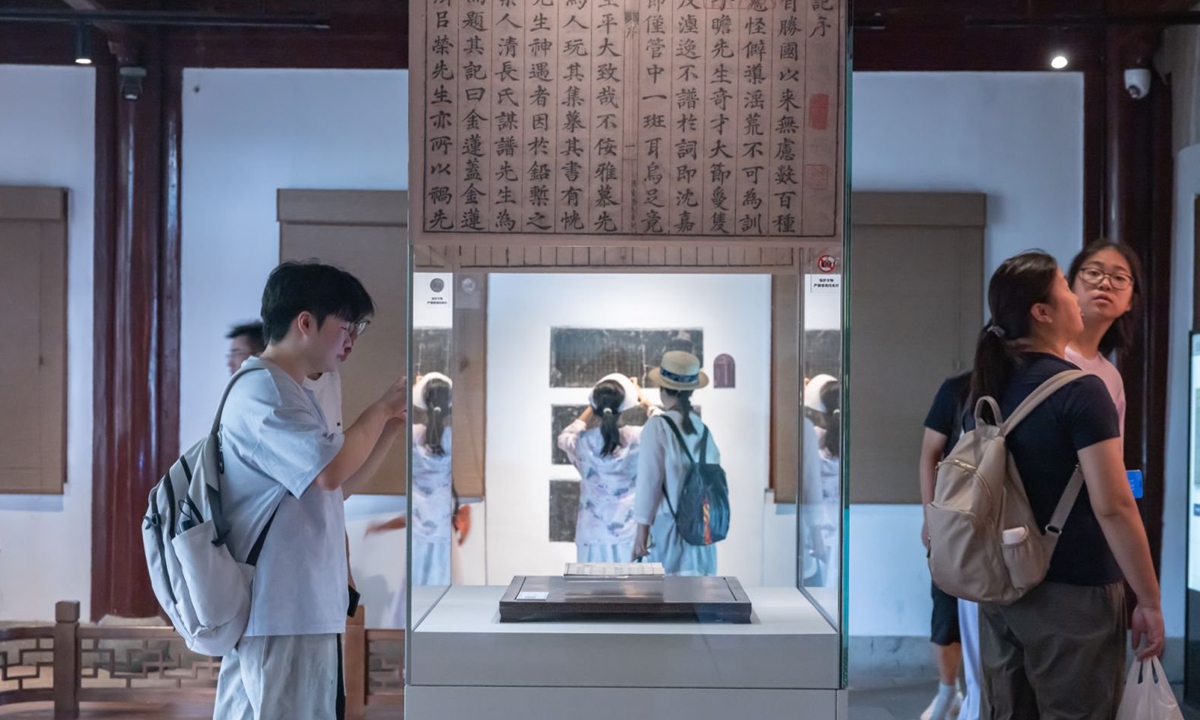
Visitors view ancient documents at Tianyige Museum. Photo: Courtesy of Tianyige Museum
Huang Gang is in his fifties. Every day, he sits before a computer screen at Tianyige Museum (Tianyige), flipping through ancient books - digitally.
As director of the information technology department at Tianyige Museum in Ningbo, East China's Zhejiang Province, home to Asia's oldest surviving private library and one of the world's three oldest remaining family-run libraries, his job title may seem far removed from old books. Yet his work centers on them: converting brittle, thread-bound antique volumes into searchable, zoomable digital files accessible on screen.
For years, Tianyige has carried out digitization in batches guided by its mission: rescue-oriented preservation, scholarly organization and public-oriented outreach. Its teams have scanned more than 3.4 million pages of ancient texts. The institution rolled out its Ancient‑Book Digital Service Platform back in 2009. By 2025, the platform had drawn over 4.6 million total visits.
To outsiders, this might look like a headlong rush into digitization. For Huang and his colleagues, it is delicate work balanced between fast‑evolving artificial intelligence models and the reverence owed to fragile paper relics. "Technology is a tool, ancient books are artifacts, and reading is the ultimate purpose," Huang told the Global Times.
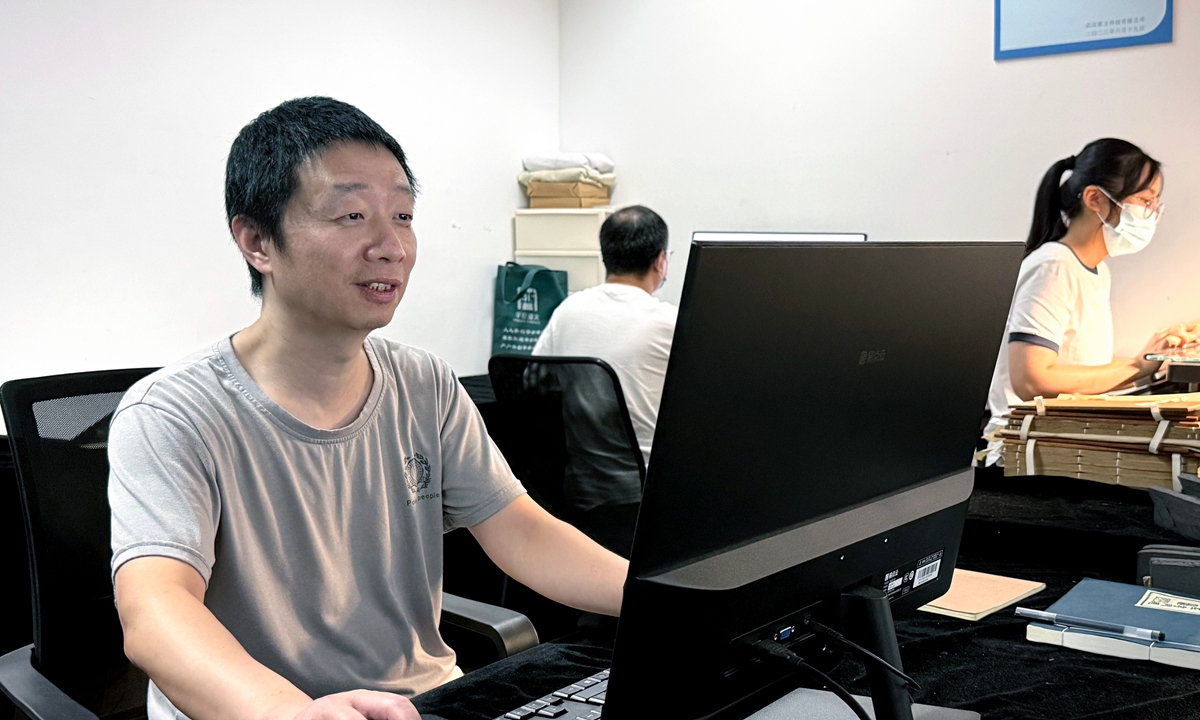
Huang Gang, director of the information technology department of Tianyige Museum, works on the digitization of ancient books. Photo: Courtesy of Tianyige Museum
Beyond tech boundariesDeep in the storage vaults of Tianyige, tens of thousands of ancient volumes rest in silence. Some pages are curled and fragile; others bear faded script -the accumulated marks of centuries. Vulnerable to aging, wear and external damage, these precious paper relics can hardly sustain long-term repeated manual consultation, making digital preservation an indispensable way to inherit ancient book resources.
Huang's daily work involves leading his team in the digitization of the library's entire collection of ancient books, paintings and cultural relics, bringing rare treasures out of the shadows and into public view.
AI now serves as a core auxiliary tool for ancient-book digitization and research. Huang's group initially built character-recognition frameworks based on optical-character-recognition technology. By cross-checking outputs across different models, ancient Chinese characters, damaged script and blurry handwriting.
According to Zhejiang Daily, by August 2025, the Tianyige's digital platform had added over 3,700 new digitized book sets, lifting its total digital holdings past 20,000 volumes.
Digitization is never a purely technical exercise; in-depth scholarly expertise in ancient texts remains indispensable. Huang frequently collaborates with Zhao Xuteng, a museum librarian specializing in classical literature. Zhao is responsible for selecting which volumes to digitize, evaluating editions, studying content, and identifying works of significant academic or public value. While one team focuses on the technical execution, another digs deep into the textual substance, ensuring that cold digital capture remains faithful to the historical and bibliographic logic of the originals.
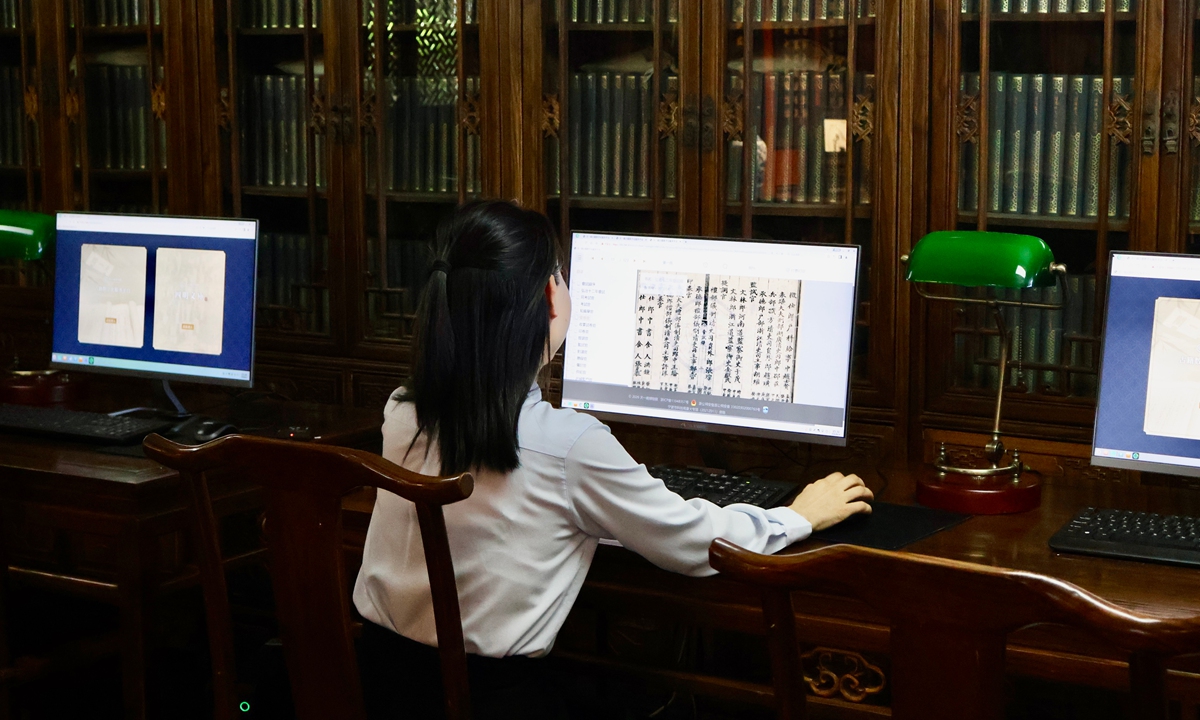
A staff member of Tianyige Museum view digital resources of ancient documents in the museum's ancient book reading room, on August 18, 2026. Photo: Lin Xiaoyi/GT
Staying true to readingWhen he is not writing code, Huang keeps asking one fundamental question: What should technology actually do for people? "All technology ultimately serves the act of reading itself," he said. "It can never replace that."
With the rapid rise of large language models, demand for high-quality text corpora has surged. Overseas, some AI companies have reportedly purchased millions of printed books in bulk, scanned them and then shredded the originals.
"Machines can efficiently compile documents, retrieve sources and generate explanatory notes. Real engagement with ancient texts, however, is far more than mechanical assembly of characters," Huang noted.
Both Huang and Zhao stressed that human beings sit at the heart of cultural inheritance. People absorb wisdom from old texts, draw on personal experience and scholarship to reflect, and produce new knowledge - an intellectual process no AI can fully replicate.
The Global Times learned that every digitization workflow at Tianyige follows strict closed-loop protocols: collection checkout logging, noncontact scanning, AI-powered quality checks, precise image stitching and compliant online publication. The full procedure minimizes physical wear on original artifacts.
"A book is, first and foremost, a cultural relic that carries a thousand-year legacy," Huang said. "Only secondarily is it a text to be read." That principle, he added, is shared by all guardians at Tianyige.
"Media change, technologies evolve, but the essence of reading has never changed," he stressed.
Today, drawing on its comprehensive digital collections, Tianyige hosts monthly exhibitions of rare texts and organizes family reading events where parents and children explore the classics together. For Huang and his colleagues, the most gratifying reward is watching more and more ordinary people develop a love for ancient reading and a deeper appreciation for the traditional Chinese culture.
In an era swept by artificial intelligence, Tianyige's guardians tend to fragile paper relics while leveraging modern technology, preserving the genuine power of reading. More than 450 years of scholarly heritage flows onward, passing between human fingertips and glowing digital screens.
。
Current article:http://www.zhanggengsenchaiweikeng.cfd/i0d4/20260826/1306.docx
Published on:01:54:41


 老人感觉“不怎么热”,硬扛没开空调突发心梗
 LOL播放器MLXG电磁炉煮火锅:中国消防大佬
 《红色沙漠》新更新加入“水面奔跑”机制 玩家可踏水疾行引热议
 特朗普打响史上最严经济战,整个波斯湾将犹如铁桶,全球警报拉响!,兵器要闻,原创 特朗普打响史上最严经济战,整个波斯湾将犹如铁桶,全球警报拉响!
 内塔尼亚胡:美国和伊朗“不可能”达成外交协议,还和特朗普讨论了再次打击伊朗和加强对伊封锁
 王鑫的马桶mt被腾讯“屏蔽”,在推出之夜被多个频道“屏蔽”。


