初恋日记
Gay and targeted in Uganda: Inside the extreme crackdown on LGBTQ rights_我的网站

A |
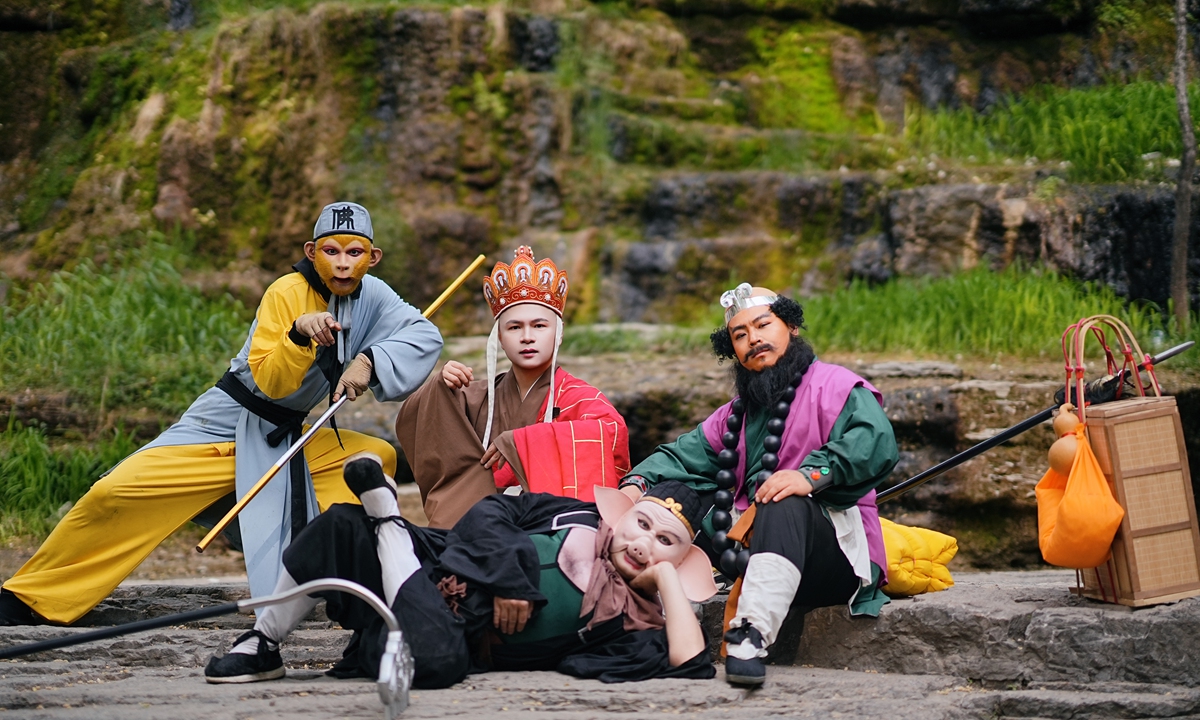
Livestreaming team of Journey to the West: Heroes' Gathering, featuring the four master-disciples Photo: Courtesy of the cast team of
Journey to the West: Heroes' GatheringAt dusk, in an unassuming grove in Shouguang, East China's Shandong Province, performers dressed as Tang Sanzang (Monk Xuanzang), Sun Wukong (Monkey King) and other characters from the renowned Chinese classic Journey to the West set up a thatched hut and cooked around a bonfire while livestreaming. They were not fighting demons or embarking on a pilgrimage, but chatting, joking and improvising in response to comments from live viewers.
This seemingly makeshift
Journey to the West: Heroes' Gathering livestream has gone viral lately, with related videos garnering more than 140 million views and more than 400,000 viewers tuning in simultaneously at its peak on Douyin, the Chinese version of TikTok. Netizens gave it a distinctly contemporary nickname — the "2026 version of
Journey to the West."
Behind the viral success is a format far removed from traditional film and television productions: The livestream does not rely on tightly scripted dialogue.
Gao Guancheng, director of the team, told the Global Times that the team usually prepares only a basic outline before each livestream, leaving about 80 percent of each livestream to improvisation.
"Comments from viewers, trending internet memes, and even unexpected incidents on site can all become the starting point for the next scene," he said. This seemingly spontaneous approach, however, is far from unprepared.
Into daily lifeThe performers playing the "four pilgrims" all have years of experience portraying characters from
Journey to the West. That experience has given them the chemistry needed to pick up and build on one another's cues during livestreams.
"The actor playing Tang Sanzang has years of rich experience imitating the character, the actor playing Sun Wukong has studied monkey opera since childhood, and the actor playing Zhu Bajie has been portraying the character for nearly 20 years," Gao said.
"One look, one movement, or one punchline, we all know who should pick it up and who shouldn't," he added.
That chemistry may be the foundation for bringing the characters to life, but what truly connects this new
Journey to the West with contemporary life is the seemingly ordinary daily routine.
Peng Tao, a young viewer in his 20s who works in the internet industry, told the Global Times that when he first came across Journey to the West: Heroes' Gathering, he felt as if he were watching a spin-off of Journey to the West, one in which familiar characters were simply going about their daily lives.
"In the past, we saw them on the pilgrimage and fighting the demons. Now we see them eating together, chatting and working. That contrast really draws me in," he said.
In his view, the relationships among Tang Sanzang and his disciples remain familiar, but placing them in everyday situations gives those relationships a new resonance.
"For example, at work, there may be a relatively domineering boss, someone who always rushes to take responsibility, someone who keeps the atmosphere lively, and someone who doesn't say much but always gets things done in the end. You start to feel that they're no longer mythical figures, but people around you," he said.
That sense of familiarity may be one way for classics to reconnect with younger audiences.
"I don't think they are doing
Journey to the West a disservice," Peng said. "The basic personalities of the characters are still there; they've simply been placed in a new setting. If a classic can only be told in the same way it was decades ago, it may actually become increasingly distant from young people."
Finding the right balance between the old and the new is also something the creators of
Journey to the West: Heroes' Gathering have been thinking about.
"We are not remaking
Journey to the West. By preserving the basic characteristics of the characters while placing them in new everyday settings, we are bringing Journey to the West into the lives of ordinary people," Gao said.
Stories reimagined
The modern revival of classic traditional classics is by no means limited to Journey to the West.
Classic Chinese texts taught in schools, including
Letter to Wife,
Pipa Song and
The Golden Fishhook, have also been turned into vivid and engaging short videos. One video based on
The Golden Fishhook has garnered more than 100 million views. Such adaptations have attracted widespread attention online, according to the Beijing Daily.
These time-honored texts have become part of a generation's collective memory and naturally come with an established audience. Yet with countless classics to draw from, there is no shortage of adaptations that simply capitalize on established IPs or recycle old memes, and not every adaptation wins over audiences. What truly resonates is finding a thoughtful way to bring classics back down to earth, according to the Beijing Daily.
Beijing-based cultural scholar Wang Deyan told the Global Times that the vitality of a classic does not lie simply in repeating it word for word, but in its ability to continually forge new connections with contemporary life, emotions and aesthetics.
"Classics can continue to resonate in new eras because the relationships between their characters, their emotional structures and the values they convey can still connect with people today," he said.
In Wang's view, the popularity of
Journey to the West: Heroes' Gathering is essentially a way for young audiences to rediscover a classic through new forms of media: The characters remain the same, but the way audiences view them has changed.
"Short videos, livestreams and online fan creations have lowered the threshold for creative expression, giving classics opportunities to enter more tangible settings of everyday life," he said.
Perhaps classics truly come "alive" in moments like these, when they are no longer simply "old stories" preserved in textbooks and on screens, but enter livestreams, short videos and the everyday lives of young people, gaining new vitality in a new era through each retelling and each new way of being seen.
。 At a small shelter in Uganda, members of the LGBTQ community seek refuge from persecution after their government enacted one of the world's harshest anti-homosexuality laws earlier this year.Henry, whose full name is being withheld for safety reasons, runs the shelter along with a local clinic he says also serves the general community."Somebody has just called me that they need shelter. He has been evicted, and he's on his way," Henry told ABC News foreign correspondent James Longman.A man named Emmanuel arrives -- he says he hasn't slept in days and is seeking a place to stay to keep him off the streets. Later, he tells ABC News that he's estranged from his family and recently got kicked out of his home after the landlord spotted his boyfriend visiting."Every day that goes by, you feel like it's becoming more like you're in a box," said Emmanuel, whose full name is being withheld for safety reasons."My biggest fear is the police can find me anywhere," Emmanuel said.Despite that fear and the risk of showing his face, Emmanuel said he's tired of hiding."I wouldn't want to live in the fear. I'll stand in, to be that person who is not scared of being who I really am," Emmanuel said.Uganda has effectively made being gay illegal of what the law calls "aggravated homosexuality" -- up to life in prison or even execution. Someone simply advocating for gay rights could serve up to 20 years behind bars. Renting up a room to a gay couple could result in a 7-year prison sentence.Critically, failing to report same-sex acts to the police is also a crime, creating a culture of suspicion that people like Henry and Emmanuel have seen firsthand."Right now, I'm one of the victims of the bill," said Henry, who has been targeted and arrested before for helping gay people. Since ABC News' visit to the clinic, police raided and shut Henry's clinic down. Henry was arrested and released.
Hiding in plain sight
Just before the new law came into effect, Mona Lisa, a 29-year-old trans woman, had her home raided by Ugandan authorities. She was jailed for three months on charges of "homosexuality propaganda."Her apartment is the only place where she feels safe to be her true self. She pulls out a small suitcase from on top of a shelf. Inside, her prized outfits are stashed away in secret.Donning a bright blue and yellow-patterned wrap and matching pants, a dark brown bob, and red lipstick, Mona Lisa says, "I feel perfect. I feel like this is the Mona I want to be like on a daily basis."While there was a time when it was safer to be her true self in public, she says, "It's not happening now."Meanwhile, 27-year-old Eric was also arrested earlier this year. Inside his home, the young activist wears a striped rainbow shirt and his home is filled with color. His full name and location are being withheld for safety reasons.But it's not safe to go out like this, Eric says.For Eric and his friends, just existing is a form of defiance. On this night, going out to a club is their act of resistance."You can't go alone out -- in case something happens. You can't just go alone," Eric said.Gay clubs in Uganda have been shut down, so the group of friends head to a local dance party instead. It's not illegal to have a good time, but those who are gay understand the risks.Despite the positive energy at the party, there's potential danger lurking beneath the surface. One complaint, one annoyed neighbor, one over-curious passerby, and it could all end with police sirens and violence.Yet, for Eric and his friends, they say this release is crucial for their survival."I surround myself with people that accept me. It's important," Eric said.
Denying the law's impact: 'We look at gay as a deviation'
Asuman Basalirwa is one of the Ugandan lawmakers who sponsored the new law and says other countries should respect Uganda's sovereignty."For us, we look at gay as a deviation," Basalirwa told ABC News.During a two-hour interview with Longman, Basalirwa repeatedly denied the negative impact of the new law on LGBT Ugandans."Let me tell you, I am a lawyer here, if anybody is being persecuted for existence, give me their contacts, I'll represent them free of charge. Where are they?" Basalirwa said.But Ugandan Human rights attorney Nicholas Opiyo says, "the stories I hear every day is different from what [Basalirwa] would want to tell you.""I have people who have been raped who are afraid to go to hospitals, because of fear of being reported. I have people who are hiding in their houses and are calling me for medical help, for food," Opiyo told ABC News.
Exporting hate through evangelism
The Anglican church has spearheaded the anti-LGBTQ movement in Uganda, where more than 80% of people are Christian and nearly 14.4% of people are Muslim -- with a heavy emphasis on "traditional family."Pastor Simeon Kawiya leads a Christian church in Kampala and is a supporter of the new anti-homosexuality law. Kawiya believes that being gay is taught and not how people are born."It's not a human right to be gay. It's not," Kawaiya told ABC News."The Parliament of Uganda voted 100% in favor of anti-LGBT law. I mean, the whole country voted that way," Kawaiya continued.More than 30 African countries ban same-sex relations, according to Human Rights Watch.But some people, including preacher Kapya Kaoma, claim anti-LGBTQ sentiment on the continent has been influenced from the outside."The whole idea of the persecution of African LGBTQ people did not come from Africa. American Christian rightists are behind it," Kaoma told ABC News.While working as a preacher in Uganda, Kaoma took videos of American preachers speaking against homosexuality in the country that became part of the award-winning documentary, "God Loves Uganda."Several media outlets, including Open Democracy, have reported that U.S.-based Christian groups -- known for fighting everything from access to abortion to limiting LGBTQ right -- spent tens of millions of dollars across Africa over the last decade or more.The origins of the new anti-LGBTQ law in Uganda can be traced back to 2009, when a bill nicknamed "Kill the Gays" was drafted in parliament. It finally passed in 2014, but was struck down before it went into effect."The American Evangelicals also learned something. What they started doing is having conferences -- Africans with American Christian rightists coming together," Kaoma said.Just before the new anti-LGBTQ law went into effect earlier this year, the government of Uganda hosted a conference titled, "Protecting African Culture and Family Values," which included members of parliament and Uganda President Yoweri Museveni, who posted parts of it on his social media channels."There will be no promotion of homosexuality in Uganda," Museveni said.Ugandan state TV also showed Sharon Slater, head of Arizona-based evangelical group, Family Watch International, speaking at the conference."I cannot tell you the power that I think will reverberate across Africa that will affect the whole world from this conference…We must stop this cultural imperialism that is coming and destroying our children and our families," Slater said.Shortly after the conference, Museveni signed the anti-homosexuality bill into law."Sharon Slater cannot deny those connections, she has people working with her on the ground in Uganda," Kaoma said.Family Watch International denies it helped author Uganda's anti-LGBTQ law. According to their website, the group says it opposed the bill and the penalties, including the death penalty and the part that would punish people for not turning in others."Family Watch pleaded with Uganda's president that if he planned to sign the bill, to ensure that it be softened to include a safe-haven clause whereby people with unwanted same-sex attraction can voluntarily come forward to ask for help without fear of being arrested or penalized," a statement on their website said.Opiyo, the human rights lawyer, told ABC News, "Who I have sex with, who I love, is less important to a common person in the village.""Evangelical and cultural groups have jumped on this campaign as an issue for them, and have created a sense that there's widespread hatred in this country," Opiyo said.
Looking ahead
The United States government invests nearly $1 billion annually in Uganda, according to the U.S. Embassy in Uganda.When asked what material response the Biden administration is planning, U.S. Secretary Antony Blinken told reporters at a press conference, "[Uganda's anti-homosexuality act] infringes very clearly on the human rights of Ugandan citizens…President Biden directed the government to evaluate all aspects of our engagement with Uganda…That process is ongoing and when I have any news for you on that front, I will share it."It's unclear if U.S. sanctions would have any effect.The World Bank has already stopped lending to Uganda and the European Union denounced the bill as well.Meanwhile, many of the young people in the country who spoke to ABC News wonder how they will survive in a country determined to punish them for merely living their lives."For me, it's all about freedom. Let us live in the moment, and be loved," Mona Lisa said.
ABC News' Allie Weintraub, Jaclyn Skurie, Meagan Redman, and Stephanie Lorenzo contributed to this report.。
Current article:http://www.zhanggengsenchaiweikeng.cfd/lb4/od2a.doc
Published on:02:27:02